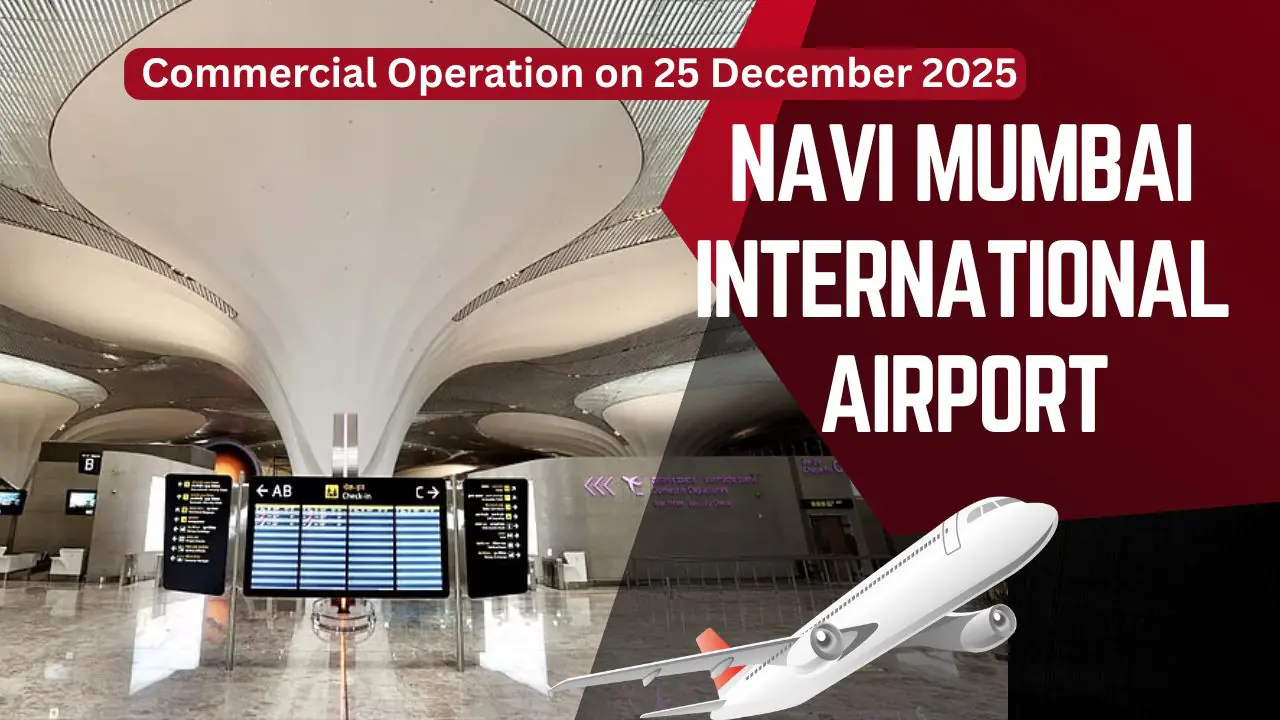
Navi Mumbai International Airport (NMIA) is no longer “upcoming”—it is entering commercial service and is positioned to become one of India’s most important aviation and logistics gateways. Built as Mumbai Metropolitan Region’s (MMR) second airport to decongest Chhatrapati Shivaji Maharaj International Airport (CSMIA), NMIA is a greenfield project in Ulwe–Panvel that is designed to scale in phases from an initial terminal to a multi-terminal mega-hub with major cargo capabilities.
This news update explains NMIA in detail—what’s ready on Day 1, which company operates it, early operating hours and inaugural flight timings, connectivity, capacity plans, and why the project is reshaping investment and real estate thinking across Navi Mumbai.
Table of Contents
NMIA launch: opening date and early operating window (launch phase)
Multiple recent reports and official-statement-based coverage indicate NMIA will begin commercial operations on 25 December 2025.
During the initial ramp-up phase, NMIA is expected to run with a controlled schedule to ensure stable operations. Coverage on the launch plan indicates an operating window of 8:00 AM to 8:00 PM (Dec 25 to Jan 25) as systems, processes, and passenger flows settle.
Why this matters: airports don’t “flip a switch” overnight. NMIA has run extensive readiness and transfer drills (ORAT) to test everything from check-in and security to boarding and baggage, aiming for smoother Day 1 performance.
Which airport company will operate NMIA?
NMIA is operated by Navi Mumbai International Airport Pvt Ltd (NMIAPL), part of the Adani Airports ecosystem (Adani Airport Holdings Ltd / Adani Airports).
For readers tracking governance and project execution: India Ratings has detailed the ownership chain linking Adani Airport Holdings, Mumbai International Airport Ltd (MIAL) and NMIAPL.
Practical tip for passengers and website readers: for live updates (services, airport facilities, flight status), NMIA’s official site is the most reliable reference.
First-day airlines and timings from NMIA (opening day 25 December, 2025)

Early operations are expected to include major domestic carriers, with multiple outlets reporting that IndiGo, Akasa Air, Air India Express, and Star Air will operate on Day 1.
Inaugural flight timings (reported schedule)
Reported opening-day milestones include:
- First arrival: IndiGo 6E460 from Bengaluru, scheduled to land at 8:00 AM
- First departure: IndiGo 6E882 to Hyderabad, scheduled at 8:40 AM
Launch coverage also points to 23 scheduled daily departures at the start, with a structured ramp-up over the following weeks/months.
“Schedules are subject to change—check airline apps and the airport’s live flight status before travel.”
NMIA: location advantage and why it’s a “multi-modal” airport
NMIA’s biggest strategic edge is not only runway and terminal capacity—it’s its position inside a fast-upgrading transport grid that connects:
- Navi Mumbai nodes (Ulwe, Panvel, Kharghar, Nerul, Belapur)
- Mumbai via new high-capacity road links
- JNPT (Jawaharlal Nehru Port) and logistics zones for cargo movement
This is why industry observers increasingly describe NMIA as a future aviation + cargo + commerce ecosystem rather than a standalone passenger airport.

Key features: terminal plan, capacity and expansion roadmap
NMIA is designed for phased expansion—starting with an initial terminal and scaling toward very large passenger volumes.
- Phase 1 terminal capacity is widely reported around 20 million passengers per annum as the airport starts operations.
- Long-term planning targets up to ~90 million passengers annually once later phases are built out.
On the design front, NMIA’s terminal architecture has been associated with a lotus-inspired concept in public reporting, with Zaha Hadid Architects frequently referenced in design coverage. (Treat design renders as conceptual until confirmed in final as-built detail.)
Cargo, logistics and “airport-city” potential
NMIA is not just passenger-focused. ACI Asia-Pacific has highlighted the airport’s cargo ambition, including an initial cargo handling capacity scale and its relevance to pharma, perishables and e-commerce supply chains.
Adani’s own communications also emphasize an integrated ecosystem—passenger terminals plus cargo infrastructure at scale—positioning NMIA as a major western India freight gateway alongside Mumbai’s port economy.
Real estate impact: where demand can rise
NMIA’s commissioning is a structural catalyst for Navi Mumbai real estate because it changes time-to-access and employment density. In simple terms: airports create jobs directly (airport operations) and indirectly (hospitality, logistics, services, retail), and those jobs pull housing demand.
Micro-markets likely to see continued interest
- Ulwe & nearby nodes: closest to the airport footprint; often first to price in “airport premium”
- Panvel: a major rail/road junction; benefits from both passenger movement and logistics
- Dronagiri / JNPT belt: strong long-term potential for logistics/industrial ancillaries
- Kharghar / Belapur / Nerul: more “mature” nodes that can benefit from corporate spillover and better connectivity
What changes after operations actually start?
A common pattern in infrastructure-driven markets is:
- Announcement rally (speculative)
- Construction-phase optimism
- Operational proof (real demand shows up—rentals, hotels, warehouses, offices)
- Ecosystem build-out (multi-year compounding)
NMIA moving into commercial operations pushes the story from “future promise” into “live infrastructure,” which is when institutional interest (hospitality brands, logistics players, office developers) often strengthens.
Caution for buyers/investors
- Verify RERA status and approvals for under-construction projects
- Track actual flight ramp-up (frequency, destinations) after launch month
- Watch infrastructure last-mile readiness (approach roads, transit links, parking, feeder services)
- Prefer developers with proven delivery record in Navi Mumbai
What businesses can win from NMIA
- Hospitality & short-stay: airport hotels, business hotels, serviced apartments.
- Logistics & warehousing: e-commerce hubs, pharma cargo, cold chain.
- Aviation services: ground handling, training, MRO ecosystem over time.
- Retail & F&B inside and around the airport: passenger spend + staff ecosystem
- Commercial offices: airline offices, freight forwarders, travel tech, back-end ops